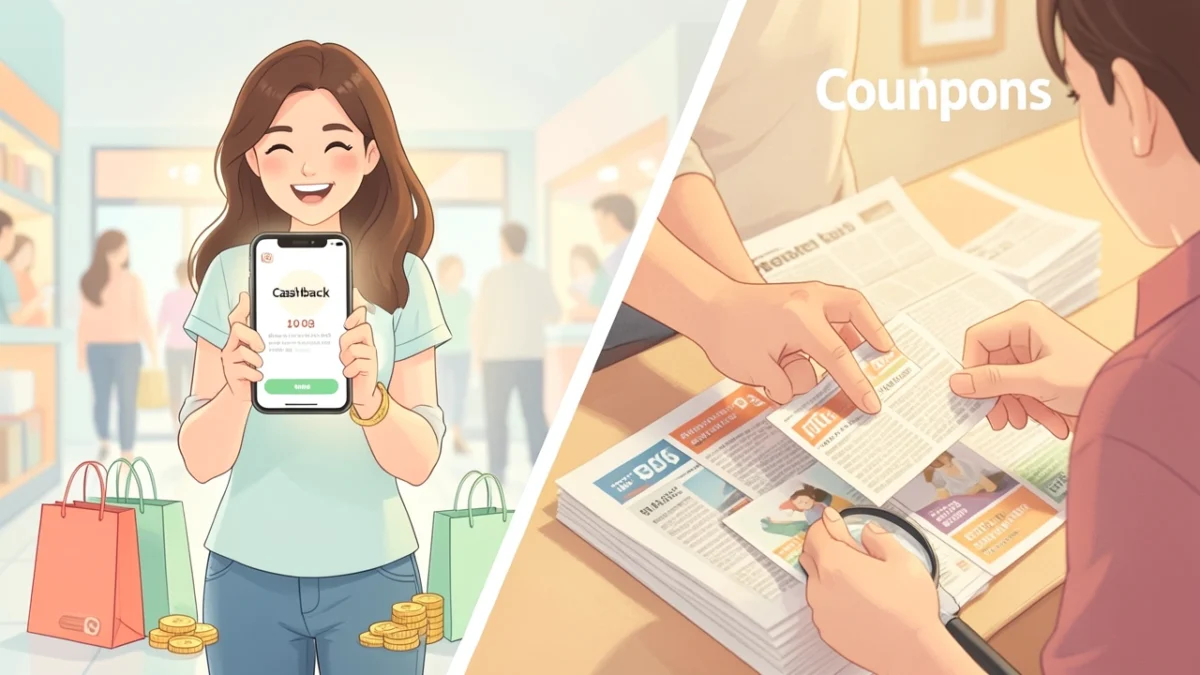
Many shoppers wonder about Cashback vs Coupons: Which Saves You More Money? It sounds simple, but sometimes it’s a bit tricky to figure out. Beginners often get confused about how each one works and how to get the most savings. Don’t worry, we’ll break it down easily.
This guide will show you step-by-step how to make the best choice for your wallet. We’ll look at how to get extra money back and how to use coupons smartly.
Understanding How Cashback Works
Cashback is like getting a small reward for shopping. When you buy something, a portion of the money you spent comes back to you. It’s a way for companies or apps to thank you for being a customer.
Think of it as a rebate that happens automatically or with a little effort from you. This system encourages you to shop with them again because you know you’ll get some money back on your purchases. It’s different from a coupon because you don’t usually need to clip anything or enter a code at the checkout.
What is Cashback?
Cashback is a popular way to save money without always needing to remember to apply a discount code. When you shop through a special app, website, or use a particular credit card, a small percentage of your purchase price is returned to you. This money can often be withdrawn as real cash, transferred to your bank account, or used as credit for future purchases.
Many different types of businesses offer cashback, from online retailers to grocery stores.
The percentage you get back can vary a lot. Some offers might give you 1% back, while others could be as high as 10% or more, especially for new customers or during special sales. It’s like a small bonus for buying things you were already planning to buy.
This makes your shopping budget stretch a little further without you feeling like you’re missing out on anything.
How Do Cashback Apps and Websites Function?
Cashback apps and websites act as middlemen between you and the stores. When you click through their link to a store and make a purchase, the store pays the cashback provider a commission. The cashback provider then shares a part of that commission with you as cashback.
It’s a win-win situation. You get money back, the store gets your business, and the cashback provider earns by connecting shoppers and stores.
These platforms often partner with hundreds or even thousands of online retailers. To use them, you usually sign up for a free account. Then, you find the store you want to shop at through the app or website.
Clicking the link from the cashback provider takes you to the store’s website. As long as you make your purchase without closing the tab or visiting other sites in between, your purchase should be tracked for cashback. Some apps also offer cashback for in-store purchases by linking your credit or debit card.
Types of Cashback
There are a few main ways you can earn cashback. One common method is through dedicated cashback websites and apps. You browse these platforms, find the retailer you want to shop at, and click their link to go to the store’s site.
Another way is by using specific cashback credit cards. Every purchase you make with these cards earns you a percentage back, often directly as a statement credit or a check.
Some loyalty programs also offer cashback. For example, a store might have its own rewards program where you earn points that can be redeemed for cash or discounts on future purchases. Digital wallets and payment apps are also getting into the cashback game, offering small rewards for using their service to pay for items.
Each method has its own rules and ways of paying out, so it’s good to know the differences.
Real-Life Example: Sarah Buys a New Laptop
Sarah wanted to buy a new laptop for her work. She found a great deal on a popular tech website for $800. Before buying, she checked her favorite cashback app.
The app showed that this tech website was offering 5% cashback. Sarah clicked the link from the cashback app to the tech website and completed her purchase. A few days later, her purchase was confirmed in the cashback app, and she was credited $40 (5% of $800).
This $40 was extra money she got back just for starting her shopping through the app. She could later withdraw this money or use it for other savings goals.
Benefits of Using Cashback
One big advantage of cashback is that it’s often applied automatically to your purchase total after the fact. This means you don’t have to do complex calculations or remember to input a code at checkout. It’s a simple way to get a direct monetary return on your spending.
Also, cashback can be combined with other savings methods, like coupons, for even greater discounts. This makes your money go further.
Another benefit is the sheer variety of stores that offer cashback. From everyday groceries and clothing to electronics and travel, there are many opportunities to earn money back on your purchases. This passive income can add up over time, contributing to your savings goals or helping you afford something special.
It’s a feel-good way to shop because you’re getting a little something back.
Exploring How Coupons Work
Coupons have been around for a long time. They are essentially certificates that give you a discount on a product or service. You usually present a coupon at the time of purchase to get money off the price.
They can be found in many places, like newspapers, magazines, or even online.
The main idea behind coupons is to encourage people to try a new product or to reward loyal customers. They can be for a specific dollar amount off, like $1 off a carton of milk, or a percentage off, like 20% off your total grocery bill. Understanding how to find and use coupons effectively can lead to significant savings over time, especially if you are a savvy shopper.
What is a Coupon?
A coupon is a voucher, usually paper or digital, that entitles the holder to a discount on a product or service. When you use a coupon, you pay less for the item than its original price. Coupons can be for a fixed amount, like $5 off, or a percentage, like 15% off.
They are a direct way to reduce the price of your purchase at the point of sale.
Stores use coupons to attract new customers, clear out old inventory, or encourage people to buy specific brands. They are a very direct form of saving, as you see the discount applied right away on your receipt. Many coupons have expiration dates, so it’s important to use them before they run out.
Types of Coupons
There are several kinds of coupons you might come across. Manufacturer coupons are issued by the company that makes the product. Store coupons are issued by the retailer where you plan to shop.
You might also find digital coupons that you can load onto a store loyalty card or an app, or printable coupons you get from websites.
Some coupons are for specific items, while others might be for a percentage off your entire purchase. There are also “buy one, get one free” (BOGO) offers, which are a very popular type of coupon. Understanding the differences helps you maximize your savings.
For example, if a store allows you to use both a manufacturer coupon and a store coupon on the same item, your savings can be quite large.
How to Find and Use Coupons
Finding coupons can be a fun treasure hunt. You can look in your local newspaper’s Sunday edition, in grocery store flyers, or on coupon websites. Many stores also have their own apps where you can find and “clip” digital coupons directly to your loyalty account.
Social media pages of your favorite brands or stores are also good places to look.
Using coupons is usually straightforward. For paper coupons, you simply hand them to the cashier at checkout. For digital coupons, you might need to scan a barcode from your phone or have the cashier scan your loyalty card.
Always check the coupon’s terms and conditions, especially the expiration date and any specific product requirements. Make sure the coupon is valid for the item you are buying.
Real-Life Example: Mark Buys Groceries
Mark needed to buy groceries for the week. He had a coupon from the newspaper for $1 off any two boxes of cereal. He also had a store coupon for 15% off his total grocery bill.
At the checkout, he gave the cashier the cereal coupon first. The price of the two boxes of cereal was reduced. Then, the cashier scanned his loyalty card, and the 15% discount was applied to the new total after the cereal coupon was used.
This combination of coupons helped Mark save more money than if he had only used one.
Benefits of Using Coupons
The most obvious benefit of coupons is the immediate discount they provide. You see the savings right away on your receipt. This direct saving can make shopping more affordable, especially for families or those on a budget.
Coupons can also introduce you to new products you might not have tried otherwise.
Using coupons effectively can also lead to better planning of your shopping trips. You might stock up on items when you have coupons for them, which can save you money in the long run. It encourages a more mindful approach to spending, as you look for deals rather than buying impulsively.
Some people even enjoy the challenge of finding the best coupons and combining them for maximum savings.
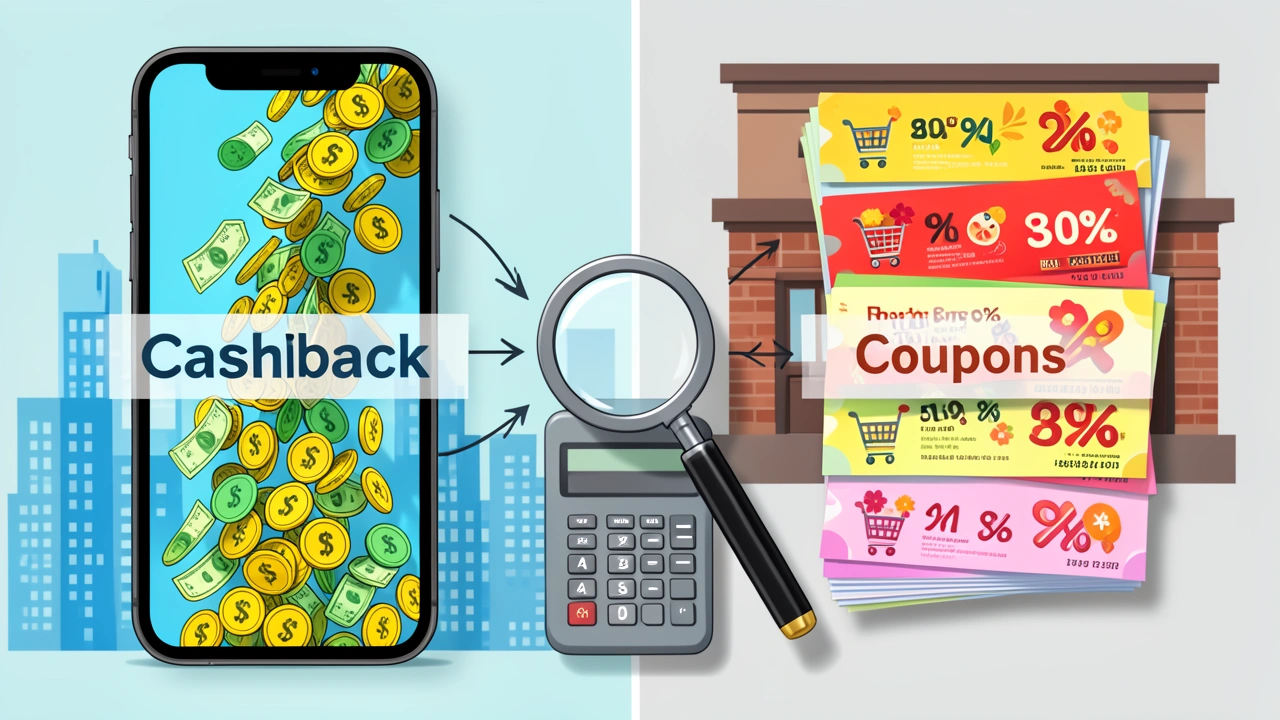
Cashback vs Coupons: Which Saves You More Money?
Deciding whether cashback or coupons will save you more money depends on how you shop and what you’re buying. Both are great tools, but they work differently. Sometimes, one is clearly better than the other, and other times, they can work together.
The goal is to combine them to get the best overall deal. This section will help you figure out how to do that. We’ll look at the situations where each shines and how to use them in partnership for maximum savings.
It’s not always an either/or situation; often, it’s a both/and strategy.
Comparing Savings: The Mechanics
Cashback is usually a percentage of your spending that you get back after the purchase. For example, if you spend $100 and get 5% cashback, you get $5 back. Coupons, on the other hand, reduce the price you pay at the moment of purchase.
If you have a $10 off coupon on a $100 item, you only pay $90. The $10 saving is immediate.
The key difference is the timing of the savings. Cashback is a refund you receive later, while a coupon is an upfront discount. This can make coupon savings feel more impactful because you see the lower price immediately.
However, the total amount saved can sometimes be higher with cashback, especially if you are making a large purchase or using cashback programs frequently.
When Cashback Might Save More
Cashback often shines when you’re making large purchases where a percentage off can add up significantly. For instance, buying a new appliance, booking a flight, or purchasing electronics can yield substantial cashback amounts. If a store offers 10% cashback on a $500 item, that’s $50 back in your pocket.
A coupon might only offer $20 off that same item.
Also, if you are shopping online and find a store offering high cashback rates, it can be very beneficial. Many online retailers partner with cashback sites, and these rates can sometimes be higher than typical coupon discounts. For everyday shopping where you might not find specific coupons for everything, a general cashback offer can provide consistent savings across many purchases.
When Coupons Might Save More
Coupons are often better for smaller, everyday purchases or when you need a specific item. If you need a particular brand of toothpaste that costs $3, and you have a $1 off coupon, you pay $2. This is a 33% saving on that item, which is very significant.
Finding a coupon that offers a large percentage off a specific item or a good dollar amount off your total bill can be extremely effective.
Coupons are also incredibly useful when stores run sales. If an item is already 50% off, and you have a coupon for an additional 20% off, you can get a massive discount. For example, an item that was $100 is on sale for $50.
A 20% off coupon would then reduce the price by another $10, making it $40. This kind of stacking of discounts is where coupons truly excel.
Combining Cashback and Coupons: The Ultimate Strategy
The smartest way to save the most money is often by combining both cashback and coupons. Many cashback programs allow you to use coupons in conjunction with their offers. This means you can get an upfront discount from a coupon and still earn cashback on the reduced price.
This strategy delivers savings at two points: at checkout and after the purchase.
For example, you find a product for $50. You have a coupon for $10 off, so you pay $40 at the register. If the cashback app offers 5% cashback on that store, you will get 5% of the $40 you paid, which is $2.
In total, you saved $10 with the coupon and $2 with cashback, for a total of $12 saved on a $50 item. This is significantly more than using just one method.
Sample Scenario: Buying Clothes
- Sarah wants to buy a dress that costs $60.
- She finds a coupon online for 20% off any clothing item. This coupon will reduce the price by $12 (20% of $60), making the price $48 at checkout.
- Before heading to the store (or shopping online), she checks her cashback app. The clothing store offers 4% cashback.
- Sarah uses her 20% off coupon and pays $48.
- After the purchase, she gets 4% cashback on the $48 she spent. This is $1.92 ($48 * 0.04).
- Her total savings are $12 from the coupon plus $1.92 from cashback, totaling $13.92.
This combined approach maximizes her savings on the dress. If she had only used the coupon, she would have saved $12. If she had only gotten 4% cashback on the original price ($60 * 0.04 = $2.40), her savings would have been much lower.
Table Comparison: Savings Potential
| Scenario | Initial Price | Coupon Savings | Price After Coupon | Cashback Percentage | Cashback Amount (on discounted price) | Total Savings | Final Price Paid |
|---|---|---|---|---|---|---|---|
| Coupon Only | $100 | $20 (20%) | $80 | N/A | N/A | $20 | $80 |
| Cashback Only | $100 | N/A | $100 | 10% | $10 (10% of $100) | $10 | $90 |
| Coupons + Cashback | $100 | $20 (20%) | $80 | 10% | $8 (10% of $80) | $28 | $72 |
As the table shows, combining coupons and cashback offers the highest total savings. The key is to apply the coupon first to lower the amount you pay, and then earn cashback on that lower amount.
Statistics on Consumer Savings
Consumers who actively use both coupons and cashback programs can see significant increases in their savings. A survey by Consumer Reports found that shoppers who use coupons regularly save an average of $50 per month. When you add cashback, this figure can easily double.
For example, if a shopper saves $50 with coupons and earns an additional $30 in cashback per month, their total monthly savings reach $80.
Furthermore, research indicates that over 90% of consumers use coupons at least occasionally. Meanwhile, the use of cashback apps and credit cards has surged, with millions of users earning billions of dollars annually. This shows that these savings methods are not just theoretical; people are actively using them to reduce their spending and put more money back into their pockets.
For instance, one popular cashback platform reported paying out over $1 billion to its users in a single year, demonstrating the massive scale of these savings opportunities.
Tips for Maximizing Savings
To get the most out of your shopping, it’s essential to have a smart strategy. This involves knowing where to look for deals and how to use the tools available to you. Simple habits can lead to big savings over time.
We’ll cover how to organize your savings efforts, what to watch out for, and how to make sure you’re always getting the best possible price. These tips will help you become a more confident and effective shopper.
Organize Your Savings Tools
Keeping track of your coupons and cashback apps can be a challenge. Consider using a binder or a dedicated folder for paper coupons, organized by category or expiration date. For digital coupons and cashback apps, create a dedicated folder on your phone for easy access.
Many cashback apps allow you to set reminders for expiring offers or popular retailers.
- Digital Folder: Create a specific folder on your smartphone for all your cashback and coupon apps. This makes them easy to find when you’re ready to shop.
- Expiration Dates: Regularly check the expiration dates on your paper and digital coupons. Plan your shopping trips to use them before they expire.
- Favorites List: Many apps let you mark your favorite stores or offers. Use this feature to quickly see the deals that matter most to you.
Having a system helps prevent missed savings opportunities. It also makes the process of saving money less overwhelming.
Always Check for Both Options
Before making any purchase, especially online, make it a habit to check for both coupons and cashback offers. Search for coupon codes on reputable coupon websites. Then, open your cashback app or website and see if that retailer offers any cashback.
Even if the cashback rate is small, like 1% or 2%, it can still add up over many purchases.
For example, if you’re buying something for $50, a 2% cashback offer is $1. Combined with a coupon, this $1 can be a nice little bonus. Don’t assume one option is always better; always investigate both.
Read the Fine Print
Both coupons and cashback offers come with terms and conditions. Coupons might have restrictions on which products they apply to, or they might be valid only at certain stores. Cashback offers might have minimum purchase requirements or exclusions for certain categories of items.
Always read the fine print to avoid surprises at checkout or when your cashback payout is processed.
- Coupon Exclusions: Look for phrases like “not valid on sale items” or “limit one coupon per purchase.”
- Cashback Limitations: Check if certain product types or shipping fees are excluded from cashback calculations.
- Minimum Payouts: Some cashback programs have a minimum amount you need to earn before you can withdraw your money.
Understanding these details ensures you meet all the requirements to get your savings.
Sample Scenario: Online Electronics Purchase
- John wants to buy a new Bluetooth speaker for $100.
- He searches for coupon codes for the online electronics store and finds one for $15 off a purchase of $75 or more. This coupon brings the price down to $85 at checkout.
- Next, he opens his preferred cashback app. The app shows that the electronics store is offering 6% cashback.
- After using the coupon and paying $85, John receives 6% cashback on that amount. This means he gets $5.10 back ($85 * 0.06).
- His total savings are $15 from the coupon plus $5.10 from cashback, resulting in $20.10 saved.
This scenario demonstrates how combining a good coupon with a decent cashback rate can significantly reduce the cost of a purchase.
Stay Aware of Special Promotions
Many cashback apps and coupon sites run special promotions. These can include increased cashback rates for a limited time, bonus cashback for signing up new members, or special coupon bundles. Keep an eye on your email newsletters from these services and their social media pages to take advantage of these opportunities.
- Double Cashback Days: Some cashback providers offer double or triple the usual cashback rates on specific days or for certain retailers.
- Bonus Offers: Look for sign-up bonuses when joining new cashback apps or referral bonuses when you invite friends.
- Seasonal Sales: Coordinate coupon use with major sales events like Black Friday or holiday clearances for the biggest discounts.
These extra boosts can significantly increase your overall savings.
Cashback vs Coupons: Which Saves You More Money?
So, to answer the question Cashback vs Coupons: Which Saves You More Money?, it’s not usually one or the other. Both offer fantastic ways to spend less. Coupons give you an immediate price reduction, which is great for making purchases more affordable right away.
Cashback gives you money back after you buy, acting like a small refund that adds up over time.
The real winner is when you use them together. By combining coupons with cashback offers, you get savings at two different points in your shopping process. This combined approach often leads to the most money saved on your purchases.
Always look for both opportunities to get the best possible deal. Smart shoppers know how to leverage both tools to their advantage.
Frequently Asked Questions
Question: Can I use a coupon and get cashback on the same purchase?
Answer: Yes, in most cases. Many cashback programs allow you to use coupons. You apply the coupon at checkout for an upfront discount, and then you earn cashback on the lower, discounted price you paid.
This combination usually saves you the most money.
Question: Is cashback always a percentage, or can it be a fixed amount?
Answer: Cashback can be offered as both a percentage of your purchase or a fixed dollar amount. For example, you might get 5% back on your groceries or $10 back on a specific electronics purchase. Both methods reduce the amount you ultimately spend.
Question: Do I need to sign up for accounts to get coupons or cashback?
Answer: For most digital coupons and cashback offers, yes, you will need to create a free account. This allows the services to track your savings and send you your rewards. Some very basic paper coupons might not require any signup.
Question: How long does it take to receive cashback?
Answer: The time it takes to receive cashback varies depending on the provider. Some might credit your account within a few days, while others might take a few weeks to confirm the purchase. You can usually withdraw your earned cashback once you reach a certain minimum amount, often via PayPal, bank transfer, or gift cards.
Question: Are cashback offers on credit cards different from cashback apps?
Answer: Yes, they are different in how you earn them. Cashback credit cards automatically give you rewards on all purchases made with the card. Cashback apps typically require you to click through their link to a retailer’s website before shopping, or scan a receipt for in-store purchases.
Both save you money, but the process is distinct.
Final Thoughts
To save the most money, always look for both coupons and cashback. Coupons give you an instant price cut. Cashback gives you money back later.
Using them together is the smartest way to get the biggest savings. Always check for both before you buy anything to make sure you’re getting the best deal possible.